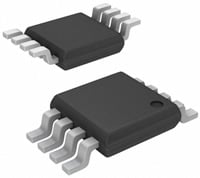
 Texas Instruments' INA826/7 are low-cost instrumentation amplifiers (INA) that offer extremely low power consumption and operate over a very wide single- or dual-supply range.
The INA826 has a single external resistor sets any gain from 1 to 1000. It offers excellent stability over temperature, even at G > 1, as a result of the low gain drift of only 35 ppm/°C (max). It is optimized to provide excellent common-mode rejection ratio of over 100 dB (G = 10) over frequencies up to 5 kHz. In G = 1, the common-mode rejection ratio exceeds 84 dB across the full input common-mode range from the negative supply all the way up to 1 V of the positive supply.
The INA827 is optimized for the lowest possible gain drift of only 1 ppm per degree Celsius in G = 5, which requires no external resistor. However, a single external resistor sets any gain from 5 to 1000. It is optimized to provide excellent common-mode rejection ratio (CMRR) of over 88 dB (G = 5) over frequencies up to 5 kHz. In G = 5, CMRR exceeds 88 dB across the full input common-mode range from the negative supply all the way up to 1 V of the positive supply.
| INA826 Features |
|
INA827 Features |
- Input common-mode range: includes V-
- Common-mode rejection:
- 104 dB, min (G = 10)
- 100 dB, min at 5 kHz (G = 10)
- Power-supply rejection: 100 dB, min (G = 1)
- Low offset voltage: 150 µV, max
- Gain drift: 1 ppm/°C (G = 1), 35 ppm/°C (G > 1)
|
|
- Eliminates errors from external resistors at gain of 5
- Common-mode range goes below negative supply
- Input protection: Up to ±40 V
- Rail-to-rail output
- Supply current: 200 µA (typ.)
|







 Innstillinger
 Rask levering
 Gratis frakt
 Incoterms
 Betalingstyper


 Markedsplass-produkt


 Texas Instruments' INA826/7 are low-cost instrumentation amplifiers (INA) that offer extremely low power consumption and operate over a very wide single- or dual-supply range.










 Norge
Norge