Innstillinger
 Rask levering
 Gratis frakt
 Incoterms
 Betalingstyper


 Markedsplass-produkt


Hall Effect Sensor Basics
The Hall Effect is a phenomenon that was discovered by Edwin Hall in 1879. He noticed that when current is flowing through a conductor and exposed to a magnetic field, voltage will be present perpendicular to the current and the magnetic field. The discovery of this effect gave us an easy way to detect magnetic fields.
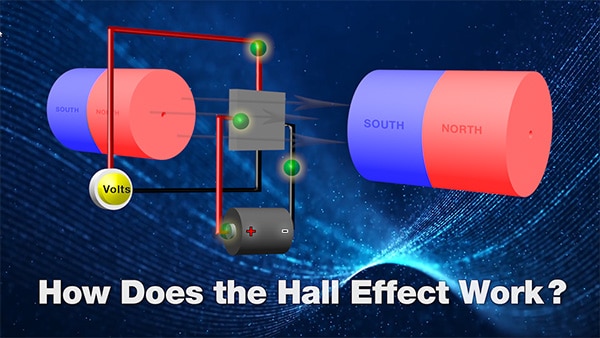
We use this effect today to sense proximity, position, current, rotational speed, and also for switching applications. Hall Effect Sensors have many pros to using them. They are solid state, which means there’s no contact bounce, they have a longer lifespan, and can be used in high-speed applications. They can also be used in severe conditions, with a lower price point than a mechanical switch.
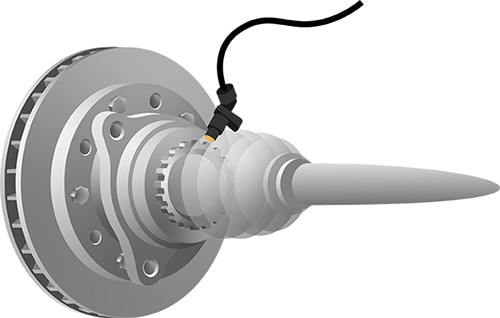
The image above is one example of a common Hall Effect Sensor application. In this example, a Hall Effect Sensor is placed between a magnet and the teeth on the gear of a car’s axle. Every time a tooth passes by, the magnetic field fluctuates and triggers the sensor. This is used to calculate speed and also help traction control systems determine if the wheels are rotating in sync.
This effect can also be used to determine proximity or position based on the strength of the magnetic field, as a switch, and for current sensing. Hall Effect Sensors are an inexpensive and effective solution for many applications.
Om skribenten

Ashley Awalt er en utvikler av teknisk innhold som har vært hos DigiKey siden 2011. Hun har tatt en universitetseksamen i anvendt vitenskap (Associate of Applied Science) innen elektronikkteknologi og automatiserte systemer fra Northland Community & Technical College gjennom Digi-Keys stipendprogram. Hennes nåværende rolle er å hjelpe til med å lage unike tekniske prosjekter, dokumentere prosessen og til slutt delta i produksjonen av videomaterialet for prosjektene. På fritiden liker Ashley å – nja, vent litt, er det noe som er fritid når du har småbarn?

Have questions or comments? Continue the conversation on TechForum, DigiKey's online community and technical resource.
Visit TechForumRelaterte blogger
Flere blogger fra denne forfatteren