






 Settings
 Fast Delivery
 Free Shipping
 Incoterms
 Payment Types


 Marketplace Product

Intel® Joule™ – Intel’s Most Powerful Maker Board
2016-09-13 | By Maker.io Staff
At the Keynote for Intel Developers Forum 2016, Intel CEO Brian Krzanich introduced a new member of the maker family of dev boards by Intel, the Intel Joule compute module. This board is very similar in some ways to the Intel Edison, targeting the Internet of Things market for advanced developers. Note that this is a high end board and as such comes with a high end price tag of around $369. The Intel Joule comes in two flavours, the 550x and 570x. The high end board, 570x, features a quad-core Intel Atom running at 2.4GHz, 4GB of DDR4 RAM, 16GB of eMMC, 802.11ac, Bluetooth 4.1, USB 3.1, CSi and DSi interfaces and multiple GPIO pinouts for interacting with real world hardware.
CEO Brian Krzanich stated that the Intel Joule will be particularly useful with drones, robotics and with added support for Intel’s RealSense technology, which is a camera system much similar to the Xbox Kinect, adding future applications for VR and AR devices.
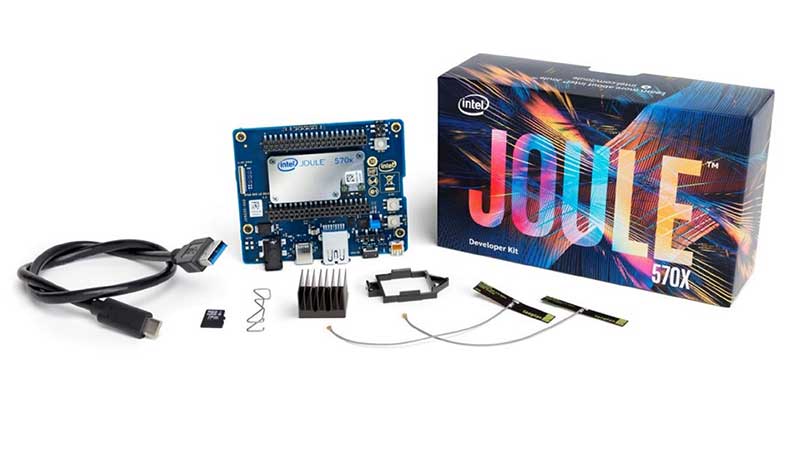
The Intel Joule dev board is small, very small in fact, similar to the Edison it has a micro form factor only as wide as a quarter. The idea behind it is to allow users to quickly prototype a concept for a particular application and take it to the next level of mass production, ultimately saving time and money along the way. Not only does the Intel Joule offer impressive processing power and memory but it also features 4K video capture and display and a much broader OS support.
Edison Vs Joule
|
Intel Joule Module |
Intel Edison Module |
|
1.5 or 1.7 GHz Intel Atom Processor |
500 MHz Processor |
|
3 or 4 GB of DDR4 RAM |
1 GB of DDR3 RAM |
|
8 or 16 GB of eMMC Flash |
4 GB of eMMC Flash |
|
802.11ac WiFI with MIMO |
Dual band 5/2.4 GHz WiFi |
|
Bluetooth |
Bluetooth |
|
Intel HD Graphics Processing Unit |
N/A |
|
RRP $369 |
RRP $89 |
As you can see from the table, the Intel Joule module has an extremely powerful processor for its small form factor. It includes a quad-core processor, giving it four usable execution threads as opposed to the Intel Edison which uses a dual-core Intel Atom clocked at 500 MHz resulting in only half of the execution threads. The Intel Joule has the ability to process more input, making a more efficient overall system. The Intel Joule has the addition of a graphics processor, something Intel is good at with their line of Intel HD graphics processors for Laptop and Desktop computers. Not only does it process video and images on-board but also provides a graphical user interface for a Desktop-like experience for end users.
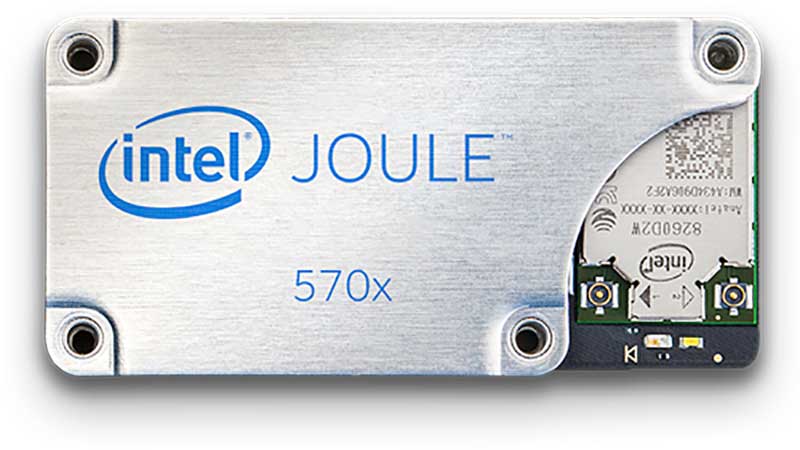
The additional memory expansion of 4 GB DDR4 RAM and up to 16 GB of eMMC Flash storage means the Intel Joule can handle much larger workloads compared to the Edison board, including graphics and multiple smaller threads.
On the software side of things, the difference between the Edison and the Joule is minimal due to the fact that they both use the same development environment with support for Intel XDK and the Intel System Studio IoT Edition. However, with the powerful hardware features of the Joule it is able to boot Linux Ubuntu Core in full desktop mode, much similar to the Raspberry Pi version.
Note: As of September 2016, Intel Joule is now fully compatible with running Windows 10 IoT Core as part of the Windows Insider Program.
Summary
Intel has stated that the Joule is aimed at professionals, however they slightly contradict themselves by noting that they have overcome some issues with beginners using the Edison by introducing a graphical interface. They say that it reduces the steep learning curve for users when using their boards. I don’t know many professional developers who are unfamiliar with using a terminal. There is a great debate about whether the Intel Joule is just another Maker board in the market or is it a serious contender for widespread IoT use in the real-world.









 Norway